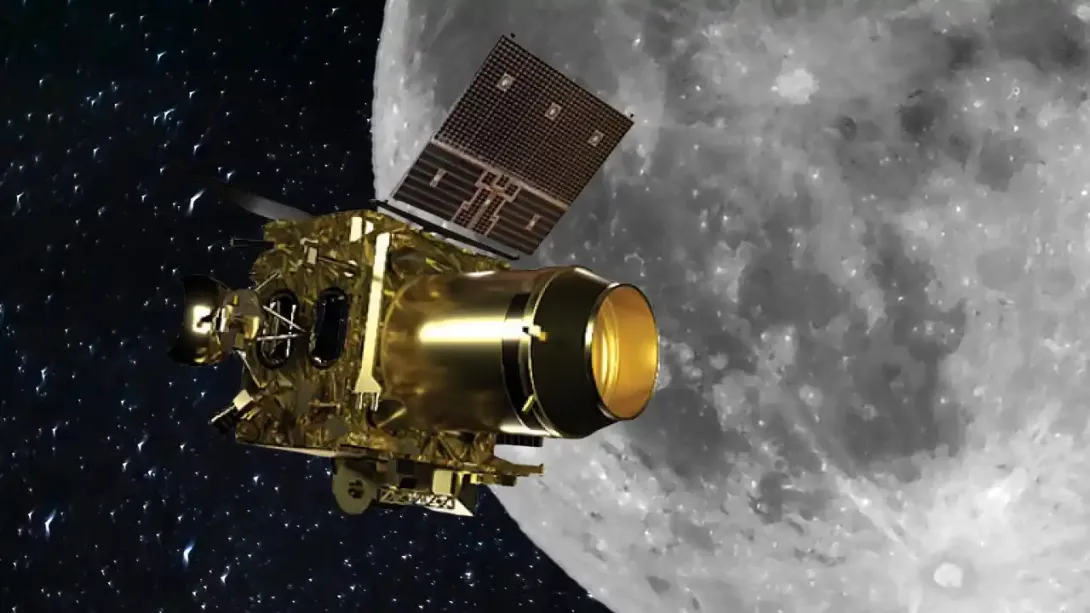
India’s Chandrayaan-2 mission has delivered groundbreaking observations, revealing how solar activity influences the lunar environment. Instruments aboard the spacecraft detected variations in charged particle flux and surface composition, offering fresh insights into the Moon’s interaction with solar wind and radiation. These findings deepen understanding of lunar space weathering, plasma dynamics, and surface evolution, providing critical data for future exploration missions. Experts emphasize that Chandrayaan-2’s observations contribute to global lunar science, supporting plans for sustained human and robotic presence on the Moon while strengthening India’s position in advanced space research and planetary studies.
Mission Overview
Launched in July 2019, Chandrayaan-2’s primary objectives included studying the Moon’s topography, mineralogy, and exosphere, with a particular focus on the polar regions. Recent data highlight how solar radiation and energetic particles interact with the lunar surface, causing:
- Alterations in surface electrostatics, which may affect dust movement.
- Changes in ionized particle density, influencing the lunar exosphere.
- Transient variations in surface reflectivity, tied to solar wind intensity.
These observations offer a comprehensive view of space weather effects on a celestial body lacking a significant magnetic field.
Scientific Insights and Findings
Chandrayaan-2’s suite of instruments, including orbital spectrometers and particle detectors, captured critical data demonstrating:
- The Moon’s surface responds dynamically to changes in solar wind speed and density.
- High-energy solar particles contribute to the generation of secondary ion populations, altering near-surface plasma characteristics.
- Observed localized surges in charged particle flux may influence dust levitation and deposition, with implications for both scientific and operational activities on the Moon.
Researchers note that these findings enhance understanding of planetary surface-solar wind interactions, relevant for other airless bodies like Mercury and asteroids.
Implications for Lunar Exploration
The data from Chandrayaan-2 carries profound implications for future lunar missions:
- Human exploration: Knowledge of charged particle behavior is crucial for designing habitats, spacesuits, and instruments resistant to solar radiation.
- Robotic operations: Surface rovers and landers must account for electrostatic dust movement, which can interfere with mechanical components.
- Resource utilization: Solar interaction studies inform strategies for extracting water ice and other volatiles at polar regions.
Indian space authorities emphasize that such insights enhance mission safety and long-term sustainability of lunar activities.
Global Significance and Scientific Collaboration
Chandrayaan-2’s observations contribute to the international lunar research community:
- Data complements findings from missions such as NASA’s Lunar Reconnaissance Orbiter and China’s Chang’e program.
- Comparative analysis improves understanding of space weathering effects across different planetary surfaces.
- Enhances predictive models for solar particle events, aiding preparation for manned and unmanned space missions.
Experts highlight that India’s contribution reinforces its role as a key player in space exploration and planetary science.
Future Prospects
Building on Chandrayaan-2’s success, ISRO plans follow-up missions including:
- Chandrayaan-3, focusing on soft-landing technology and in-situ experiments.
- Extended orbital studies of solar-lunar interactions, refining models of the Moon’s exosphere and surface dynamics.
- Collaborative projects with international space agencies to explore polar volatiles, regolith properties, and radiation shielding strategies.
These initiatives aim to ensure India remains at the forefront of lunar research, supporting both scientific discovery and technological innovation.
Conclusion
Chandrayaan-2’s recent findings demonstrate the Moon’s sensitivity to solar activity, offering unprecedented insights into its plasma environment and surface behavior. This knowledge is pivotal for future exploration, resource utilization, and long-term human presence on the Moon. As India continues to expand its space capabilities, Chandrayaan-2 serves as a testament to the nation’s scientific prowess, innovation, and contribution to global lunar science.
Comments