Tesla stock jumped 3 percent on Friday, on renewed investor optimism as Iran and United States are planning second round of talks. Nasdaq Composite and S&P 500 closed at all-time highs. Overall market sentiment has turned bullish and global markets have been following the US trends. Tesla has remained volatile but the stock has potential to create more wealth for long term investors.
The debate surrounding Tesla’s potential to achieve a $2 trillion valuation hinges less on its identity as an automaker and more on its transformation into a full-scale AI, autonomy, and robotics powerhouse. Bullish analysts argue that breakthroughs in autonomous driving, robotaxi deployment, and AI chip innovation could dramatically reshape Tesla’s earnings profile. At the same time, projects like Optimus humanoid robots and deeper integration with xAI broaden the company’s technological moat. Skeptics, however, warn that such valuations rely heavily on execution and timing, making Tesla’s future both compelling and uncertain.
Tesla’s Valuation Narrative: From Automaker to AI Platform
At the heart of the bullish thesis lies a fundamental redefinition of what Tesla represents. Rather than viewing the company purely through the lens of electric vehicle manufacturing, analysts increasingly frame it as a vertically integrated AI and robotics ecosystem. This shift in perception is critical: traditional automakers are typically valued on cyclical earnings and modest growth expectations, whereas AI-driven firms command premium multiples due to scalability and margin expansion. Proponents of the $2 trillion valuation argue that Tesla’s real asset is its proprietary AI stack—a combination of self-driving software, real-world driving data, in-house chips, and robotics capabilities. If successfully monetized, these elements could reposition Tesla into a category closer to leading technology firms rather than legacy car manufacturers.
Autonomy as the Cornerstone of Value Creation
A central pillar of the bullish case is Tesla’s push into autonomous driving, particularly through its Full Self-Driving (FSD) platform and planned robotaxi network. Analysts suggest that autonomy could unlock an entirely new revenue model, one that resembles a software-as-a-service ecosystem rather than a hardware-driven business. The logic is straightforward yet transformative: Tesla could operate a global fleet of robotaxis, generating recurring revenue. It could license its autonomous driving software to other automakers. Margins from software could significantly exceed those of vehicle manufacturing. Some projections estimate that robotaxi deployment alone could contribute up to $1 trillion in incremental valuation, provided Tesla captures a meaningful share of the autonomous mobility market.
Robotaxi Launch: The Defining Catalyst
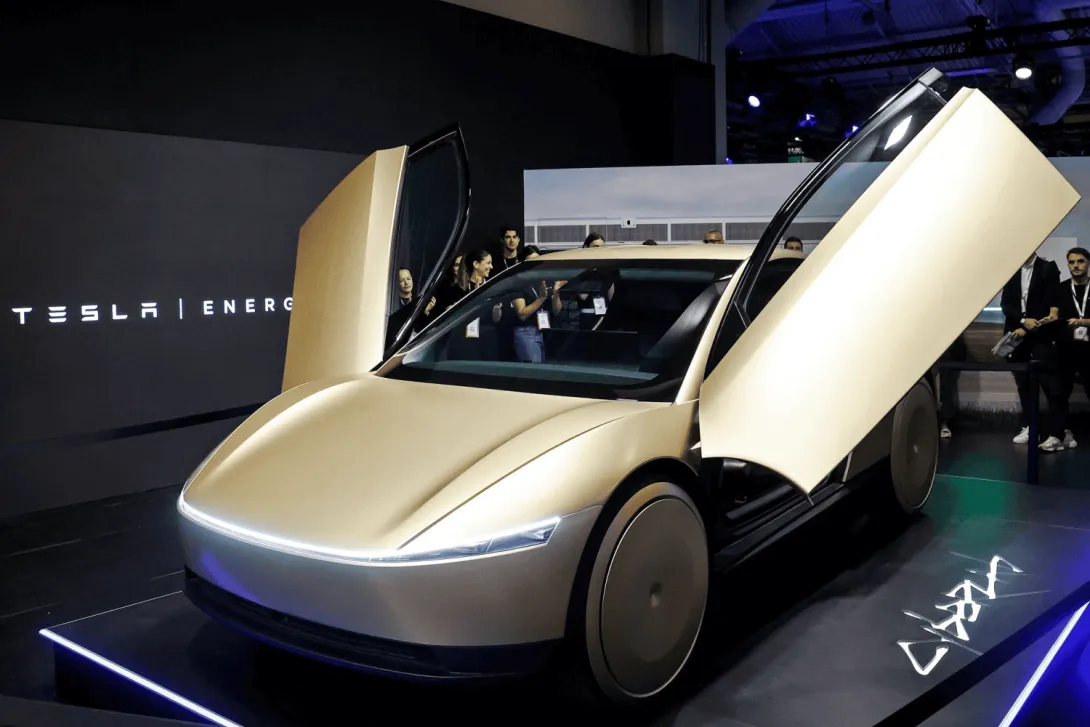
The anticipated rollout of Tesla’s robotaxi service—alongside its purpose-built Cybercab—is widely viewed as the inflection point for the stock. This moment represents more than a product launch; it signals a transition toward platform-based economics. Early testing activity in cities like Austin, with planned expansions to Phoenix and Las Vegas, underscores Tesla’s ambition to scale rapidly. If successful, the robotaxi network could: Reduce reliance on individual car sales Introduce high-margin, recurring income streams Strengthen Tesla’s competitive moat through data accumulation Investors are keenly attuned to these developments, as they may trigger a re-rating of Tesla’s valuation multiples.
AI Chips and Compute Infrastructure: Building the Backbone
Another critical component of Tesla’s long-term strategy is its investment in proprietary hardware, particularly the AI5 chip. Unlike competitors that rely on third-party solutions, Tesla is pursuing vertical integration in compute infrastructure, enabling tighter optimization between hardware and software. The significance of this approach lies in: Enhanced performance for autonomous systems Lower long-term costs Greater control over technological evolution By developing its own chips, Tesla positions itself not just as a user of AI but as a provider of foundational compute capabilities, potentially extending into data-center-scale applications.
Optimus: A Long-Duration Bet on Robotics
While autonomy drives near-term enthusiasm, Tesla’s Optimus humanoid robot represents a more speculative but potentially transformative opportunity. The vision is ambitious: a general-purpose robot capable of performing repetitive or hazardous tasks across industries. If commercialized at scale, Optimus could: Open entirely new revenue streams Address global labor shortages Reinforce Tesla’s identity as a robotics leader Some bullish narratives suggest that Optimus alone could justify a substantial portion of Tesla’s long-term valuation, though timelines and execution risks remain significant.
xAI Integration: Expanding the Intelligence Layer
Tesla’s growing relationship with xAI adds another dimension to its strategy. By integrating advanced AI models into Tesla’s ecosystem, the company aims to enhance both its autonomy systems and broader product offerings. This collaboration could accelerate: Improvements in FSD capabilities Development of more sophisticated robotics Deployment of AI-driven features across Tesla platforms The synergy between Tesla’s hardware and xAI’s software expertise strengthens the argument that Tesla is evolving into a full-stack AI enterprise.
The Numbers Behind the $2 Trillion Thesis
From a valuation standpoint, the $2 trillion target is often framed through forward-looking earnings projections. If Tesla can significantly expand its profit base by the end of the decade, such a valuation might correspond to a price-to-earnings ratio of around 40x—a level considered reasonable for a high-growth technology firm. This perspective hinges on several assumptions: Sustained growth in high-margin software revenues Successful scaling of autonomy and robotics Continued global expansion In this scenario, Tesla’s current valuation metrics would appear less stretched, as future earnings justify today’s premium.
What the Bulls Are Betting On
The optimistic outlook for Tesla is built on a series of interconnected assumptions: Full Self-Driving achieves commercial viability at scale Robotaxi networks expand without major regulatory barriers Optimus and AI products generate meaningful revenue Tesla leverages its global footprint to dominate autonomy markets Each of these factors is critical. The failure of any single element could materially impact the broader thesis.
The Bear Case: Valuation Meets Reality
Despite the compelling narrative, skeptics remain cautious. Critics argue that Tesla’s current valuation already reflects a significant portion of its future potential, leaving limited room for error. Key concerns include: Slowing growth in the electric vehicle segment Execution risks in autonomy and robotics Regulatory hurdles for robotaxi deployment Intensifying competition in AI and mobility From this perspective, the $2 trillion valuation is less a reflection of Tesla’s present fundamentals and more a high-conviction bet on an uncertain future.
Elon Musk’s Expanding Vision and Its Market Impact
Much of Tesla’s narrative is intertwined with the ambitions of Elon Musk, whose focus spans multiple groundbreaking initiatives. Beyond Tesla, Musk is deeply involved in ventures such as SpaceX and its Starship program, which aims to revolutionize space travel. Within Tesla, Musk’s priorities include: Scaling autonomous driving and robotaxis Advancing AI chip development Commercializing Optimus robots Integrating AI capabilities through xAI Investors often interpret updates on these projects as signals of Tesla’s future trajectory, which explains why the stock can react sharply to Musk-related announcements.
Why Tesla Stock Moves on Vision, Not Just Numbers
Unlike traditional equities, Tesla’s stock behavior is heavily influenced by forward-looking narratives rather than near-term financial results. Developments in autonomy, AI, or robotics can drive significant market reactions because they reshape expectations about the company’s long-term earnings power. In essence, Tesla is increasingly priced as a portfolio of disruptive technologies rather than a single-line business. This dynamic amplifies both upside potential and downside risk, making the stock particularly sensitive to news flow.
Takeaways for Long Term Investors
For investors, Tesla represents a unique blend of opportunity and uncertainty: High upside potential driven by AI, autonomy, and robotics Execution-dependent valuation, with little margin for missteps Long-term horizon required to fully realize the thesis The $2 trillion valuation narrative is not a reflection of Tesla’s current state but a projection of what it could become. Whether that vision materializes will depend on the company’s ability to deliver on some of the most ambitious technological bets in modern industry.
Comments